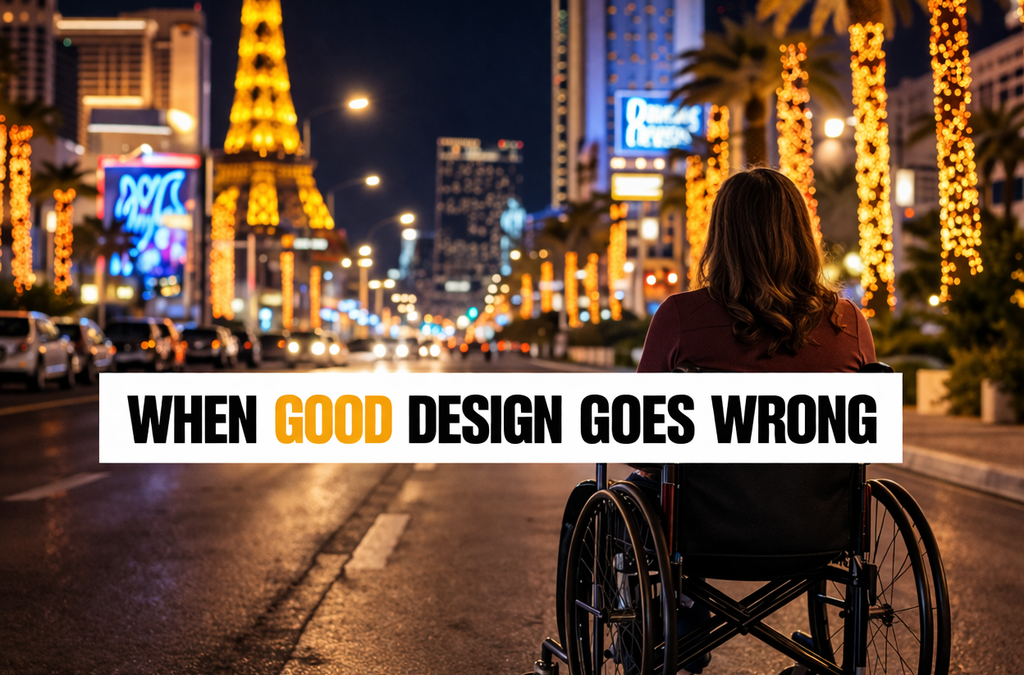
Lately, I’ve been getting a lot of calls about ADA-related cases.
And not the kind you might expect.
These aren’t just about bathrooms or grab bars. These are real-world situations where design decisions in commercial spaces — casinos, stadiums, concert venues — are creating actual safety issues for real people.
And honestly? Most of them are completely avoidable.
What’s Really Happening in These Cases
Here’s what I’m seeing over and over:
A wheelchair gets caught in a rope barrier at a casino
Someone trips on poorly designed stadium stairs
Temporary chairs at a concert block the path of travel
None of these are “design features.” They’re breakdowns in basic planning and spatial awareness.
And when design doesn’t account for how people actually move through a space — especially in high-traffic environments — things go wrong quickly.
Why Commercial Spaces Are Different (and Higher Risk)
Designing a home is one thing. Designing a public space is something else entirely.
In commercial environments, you’re dealing with:
High volume of people
Constant movement and circulation
Multiple user types (including mobility devices)
Temporary setups layered onto permanent design
That’s where ADA issues show up fast.
Because even small miscalculations — a few inches too tight, a chair placed in the wrong spot — can disrupt the path of travel and create a hazard.
ADA Isn’t Just a Checklist — It’s How People Move
One of the biggest misconceptions I see is that ADA compliance is just about hitting measurements.
It’s not.
It’s about understanding:
How someone approaches a space
How they turn, pivot, and navigate
Where they land, pause, and transition
You can technically “meet” a requirement on paper and still create a space that doesn’t function safely in real life.
That’s where experience matters.
Where Things Commonly Go Wrong
In many of these cases, the issues come down to the same core problems:
Obstructed paths of travel
Improper circulation planning
Temporary layouts that ignore accessibility
Design decisions that prioritize aesthetics over function
And in high-traffic environments like casinos and stadiums, those small decisions get multiplied thousands of times a day.
Why Attorneys Are Calling Interior Designers
This is where my work as an expert witness comes in.
Because these cases aren’t just about whether something looks right — they’re about whether it was reasonable, functional, and safe based on how people actually use the space.
Attorneys need someone who can:
Translate design into real-world behavior
Explain what a reasonable standard of care looks like
Identify when a design crosses the line from choice… to hazard
The Bottom Line
Good design should never create risk.
In commercial spaces especially, every decision — from layout to furniture placement — affects how people move, interact, and stay safe.
And when those decisions don’t account for real human behavior, they don’t just fail aesthetically… they can fail legally.
Celebrity interior designer and expert witness Lori Dennis, ASID, LEED AP, NCIDQ leads one of the top award-winning interior design firms in Los Angeles. A sought-after speaker, brand ambassador, and trusted authority in luxury design, Lori brings decades of expertise to high-profile projects, industry partnerships, and legal consulting nationwide.